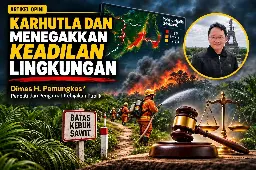
The palm oil industry is often blamed for forest fires, even though the evidence is unclear. Law enforcement must be fair and evidence-based, not based on prejudice.
SAWIT INDONESIA - Every time haze crosses national borders, the palm oil industry once again becomes the primary target. Amid public outcry and environmental diplomatic pressure, rather than identifying those actually responsible for the fires, we often witness a rush to name suspects and pass hasty public judgment without a thorough investigation—simply to satisfy the public’s curiosity. Palm oil plantation companies are often the first to be accused, even before the causes of the fires have been fully uncovered.
The announcement by the Head of the National Police’s Criminal Investigation Agency (Kabareskrim) designating 20 palm oil companies as suspects in forest and land fire cases amid pressure and administrative sanctions from Singaporean and Malaysian authorities demonstrates how quickly complex ecological disasters are reduced to simplistic legal and political matters. Of course, those proven to have set the fires must be brought to justice.
Forest destruction, the degradation of peatland ecosystems, and the suffering of communities in affected areas demand a genuine sense of justice. Nevertheless, legal proceedings must be grounded in solid factual evidence, not merely a shortcut to finding a scapegoat. Of course, those responsible for the fires must be held accountable, but the more fundamental issue is how that accountability is determined whether through verifiable evidence or through oversimplification that singles out a single sector as the sole explanation for all the problems. Burned forests, damaged peatlands, and communities breathing polluted air must not be left without justice.
This is where the line between law enforcement and scapegoating must be maintained. The palm oil industry is a vital part of Indonesia’s economy. Therefore, any alleged violations by companies must be addressed seriously, but also based on evidence, without prejudice toward the sector’s identity. Designating palm oil as a strategic industry does not mean granting it legal immunity. On the contrary, that strategic status demands that oversight and law enforcement be carried out more carefully, consistently, and accountably.
The Politicization of Haze
In the midst of a forest and land fire crisis, the government faces dual pressures: responding to domestic unrest and protests from neighboring countries. Such situations often trigger the adoption of reactive policies that prioritize swift action over thorough investigation. Sociologist Ulrich Beck once described a similar phenomenon as “organized irresponsibility”—a condition in which large-scale risks continue to unfold without clarity regarding which party actually bears proportional responsibility. Large corporations are often easy targets because their names, structures, and concession areas are easily traceable.
Taking action against corporations is easily framed as evidence of the state’s firm stance. However, administrative convenience must not replace due process of law. Law enforcement measures must be grounded in sufficient, valid evidence—not merely based on the assumption that a fire happened to break out near the boundaries of a company’s concession area. The key questions are not merely who held the concession permit when the fire broke out, but rather where the fire first ignited, how it spread, who physically controlled the location of the fire’s source, and whether there is a strong causal correlation between the actions or negligence of specific parties. A thorough field investigation is absolutely essential to ensure that the actual perpetrators do not get off scot-free, while the innocent are spared from unjust punishment.
Satellite data must be rigorously verified through on-site inspections and in-depth ecological analysis to ensure that authorities do not impose sanctions on the wrong targets. For plantation operators, the specter of forest and land fires creates multiple layers of pressure: ranging from the constraints of domestic regulations and the demands of global green standards to the threat of reputational ruin.
In reality, however, many companies have gone to great lengths to establish independent monitoring systems, maintain firefighting capabilities, and obtain international certifications such as RSPO or ISPO. Although certification alone does not automatically eliminate the possibility of violations, this track record of compliance must not be sidelined during investigations. If a corporation is proven to have properly fulfilled its mitigation and prevention obligations, this fact must be fairly taken into account. Conversely, violations must be dealt with firmly, regardless of the scale of the business or the source of its capital.
Call for Fair and Just Treatment of A Strategic Industry
Palm oil’s vital role in the national economy demands a proportional assessment. No matter how significant the contribution to foreign exchange earnings may be, it must never be used as a pretext to condone environmental destruction. Nevertheless, ecological issues must not be twisted into a justification for stifling the sense of justice through biased legal instruments. Every entity must be treated equally before the law, judged solely on the substance of its actions and the validity of the facts on the ground. Large corporations must not be granted immunity from the law simply because of their tax contributions, but neither should they be automatically found guilty merely for operating in the palm oil sector. Bilateral relations with neighboring countries must also be addressed through transparent, professional investigations, not merely by yielding to short-term diplomatic pressure.
Resolving forest and land fires requires more fundamental systemic measures than simply increasing the number of suspects: First, the fire investigation process must be supported by an environmental forensic approach that integrates satellite imagery, on-site audits, peat laboratory testing, and the involvement of academics and independent research institutions to ensure accurate and impartial results. Second, prevention strategies must be designed within a landscape framework that spans administrative boundaries and fosters collaborative synergy among governments, corporations, local communities, and civil society groups. Third, law enforcement must be accompanied by transparency so that the public receives adequate explanations regarding the objective basis for enforcement actions, free from the pressure of public opinion. Fourth, environmental diplomacy must be directed toward science-based cooperation through the open exchange of data and monitoring methodologies among neighboring countries.
Ultimately, forest and land fires are not a dichotomous choice between protecting the palm oil industry and preserving the environment; both must go hand in hand. The industry must not hide behind an economic shield, and the state must not use corporations as scapegoats to quell public opinion. The law must stand firm on the line between suspicion and evidence, between responsibility and prejudice. What the palm oil industry needs is not immunity, but justice, consistent oversight, and a legal process that can be tested to ensure the credibility of the state and the future of the environment.